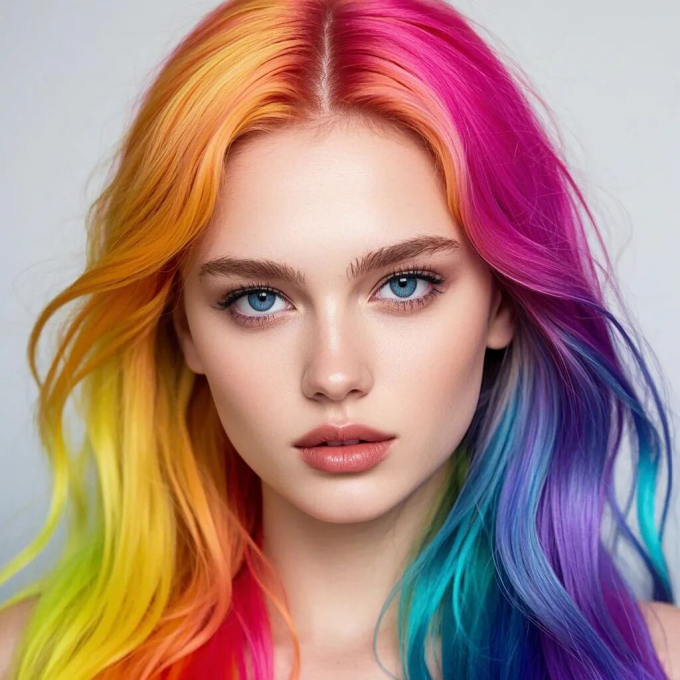
Humanity’s pursuit of hair color has spanned thousands of years—from the golden-brown curls of ancient Egyptian pharaohs to the diverse trendy hair colors on modern streets. The evolution of hair dyeing technology has always been inseparable from scientific understanding of hair itself. Since the first synthetic dye, aniline violet, was invented in 1856, oxidative hair dyes have undergone over a century of development and now form a mature industrial system. At the core of all this lies the biological structure of hair and the chemical interactions of hair dye substances. To unlock the mysteries of hair dyeing, let’s start with the “microscopic world” of hair.
I. The “Three-Layer Structure” of Hair: Nature’s Stage for Dyeing
The part of hair above the scalp (hair shaft) consists of three layers from the outside to the inside. Each layer plays a unique role in the dyeing process, and its main component, alpha keratin, is the core “target” of the coloring reaction.
1. Hair Cuticle: The “First Gateway” to Dyeing
The hair cuticle is the outermost layer of the hair shaft, composed of 6-10 layers of flat, transparent keratinocytes overlapping like “fish scales” or roof tiles, tightly wrapping the inner structure. Its core function is to protect the hair cortex while controlling the entry and exit of substances. During dyeing, the cuticle is the first “barrier” encountered by hair dye—surfactants or alkaline ingredients (such as ammonia) in the product first wet the keratinocytes, causing the gaps between the “fish scales” to expand and open up paths for dye molecules to penetrate inward.
A healthy cuticle ensures a milder and more uniform dyeing process. In contrast, damaged hair with peeling scales due to frequent perming and dyeing allows dye to penetrate too quickly, easily leading to uneven color and increased dryness and split ends.
2. Hair Cortex: The “Core Battlefield” for Color Change
The hair cortex accounts for 80%-90% of the hair shaft volume and is the “backbone” of the hair. It is composed of parallel-arranged keratin fiber bundles, with amorphous keratin and natural melanin particles filling the spaces between the bundles. It is this layer that determines the natural color of hair and the effectiveness of dyeing.
As the core area of hair dyeing, the reactions in the cortex directly determine the longevity of the hair color: oxidizing agents (such as hydrogen peroxide) in permanent hair dyes first break down the indole structure of melanin, causing the original color to fade (i.e., “decolorization”); subsequently, synthetic dye molecules (such as phenylenediamines) enter here and form covalent bonds with amino and thiol groups in keratin, generating stable new pigments to achieve long-term color locking. The efficiency of this process depends entirely on the size of the dye molecules and their reactivity with keratin.
3. Hair Medulla: The “Auxiliary Zone” for Color Uniformity
The hair medulla is located at the center of the hair shaft, composed of loosely arranged keratinocytes. It only exists in coarse hair with a diameter greater than 60 μm (fine hair may not have a medulla). Its loose structure and large gaps allow unreacted dye molecules to diffuse further into this area, enhancing the uniformity and fullness of the hair color through physical filling. However, due to its extremely low proportion in the hair shaft, it is not a key area for dyeing. Product design only needs to consider the formula compatibility for both coarse and fine hair.
4. Alpha Keratin: The “Chemical Skeleton” of Dyeing Reactions
Alpha keratin, the main component of hair, is the core chemical basis for dyeing. Its molecules form polypeptide chains in a “right-handed helix” structure, and multiple polypeptide chains are connected into stable fiber bundles through disulfide bonds (provided by a high proportion of cysteine), hydrogen bonds, etc., endowing hair with good mechanical strength and resistance to solvents and weak acids and alkalis.
Alpha keratin is particularly sensitive to oxidizing agents, reducing agents, and strong alkalis: disulfide bonds can be oxidized and broken under the action of oxidizing agents, or reduced and broken under the action of reducing agents; at the same time, amino groups (-NH₂) and carboxyl groups (-COOH) on the polypeptide chains can form covalent bonds or electrostatic adsorption with dye molecules. These two binding methods are the root cause of the difference in color retention between different types of hair dyes.
II. The Four-Step Hair Dyeing Process: A Scientific Journey from Contact to Color Locking
Based on the structure and chemical properties of hair, dyeing is essentially a “precision-coordinated” chemical process, which can be broken down into four core steps. Each step requires a perfect match between the hair dye ingredients and hair characteristics.
Step 1: Contact and Wetting—Ensuring Uniform “Adhesion” of Hair Dye
After applying the hair dye, the first task is to achieve “uniform coverage”. Surfactants (such as sodium dodecyl sulfate) in the hair dye reduce the surface tension of the hair, allowing substances such as dyes, oxidizing agents, and alkaline ingredients to uniformly wet and adsorb on the surface of the hair cuticle. The key to this step is “uniform wetting”. If the surfactant is improperly selected, it may lead to insufficient local wetting of the hair, directly causing uneven color in subsequent steps.
Step 2: Barrier Opening—Creating “Channels” for Dyes
To allow dyes to enter the hair cortex, the “protective gate” of the cuticle must first be opened. Alkaline ingredients (such as ammonia and ethanolamine) in the hair dye increase the pH value of the hair surface, causing the “fish-scale-like” keratinocytes to swell and the intercellular gaps to expand; at the same time, oxidizing agents slightly oxidize the keratin of the cuticle, further disrupting the barrier structure. The two work together to open “green channels” for dye molecules.
Subsequently, dye molecules enter the hair cortex through “concentration gradient diffusion”: small-molecule dyes (such as precursors in permanent hair dyes) have high solubility and strong diffusion efficiency, enabling them to smoothly reach the core area; while macromolecular substances in natural plant dyes (such as flavonoids) are difficult to penetrate the barrier, which is the core reason for the poor color persistence of natural hair dyes.
Step 3: Decolorization and Reaction—Making Space for New Color
After entering the hair cortex, the oxidizing agent first reacts with natural melanin: breaking down its stable structure and causing the original hair color to gradually fade, making space for new pigments. At the same time, the oxidizing agent moderately breaks the disulfide bonds of keratin, expanding the gaps between the fiber bundles in the hair cortex and further promoting the diffusion and reaction of dye molecules.
After decolorization, the binding method between dye molecules and keratin determines the type of hair dye:
- Permanent hair dye: Small-molecule precursor dyes undergo oxidative polymerization under the action of oxidizing agents to form macromolecular pigments, which form covalent bonds with the amino groups of keratin. With strong binding force, they are not easily washed off.
- Semi-permanent hair dye: Dye molecules (such as acid dyes) bind to the carboxyl groups of keratin through electrostatic adsorption. With weak binding force, they gradually fall off with daily washing.
Step 4: Diffusion and Color Locking—Ensuring Stable and Long-Lasting Color
Unreacted dye molecules continue to diffuse into the medulla, achieving uniform color through physical filling; at the same time, after the hair dye is rinsed off and the hair dries, the “fish-scale-like” cells of the cuticle gradually close, restoring the barrier function and firmly locking the newly generated pigments in the cortex and medulla.
At this point, the hair dyeing process is officially completed: the color from permanent hair dye is not easily washed off during daily cleaning, while the color from semi-permanent hair dye fades slowly—all depending on the binding method between the dye and keratin and the locking effect of the cuticle.
III. Insights into Scientific Hair Dyeing: Balancing Effectiveness and Gentleness
Today, with the maturity of the cosmetics market and the improvement of regulatory systems, the hair dye industry is moving towards “high-quality raw materials, mild formulas, and long-lasting effects”. For consumers, understanding the scientific principles of hair dyeing can help us better choose products and care for our hair:
- Damaged hair requires mild formulas: Hair with damaged cuticles should avoid products with high alkalinity and high concentrations of oxidizing agents to reduce further damage to the hair.
- Natural and synthetic dyes have their own pros and cons: Natural dyes are mild but have poor persistence, making them suitable for short-term color changes; synthetic dyes have strong color locking capabilities but may carry allergy risks—always perform a skin sensitivity test before use.
- Color uniformity depends on formula details: High-quality hair dyes optimize surfactants and dye molecule size to ensure uniform wetting and appropriate penetration, avoiding the problem of “lighter roots and darker ends”.
From the invention of synthetic dyes in the 19th century to today’s precision formulas, every breakthrough in dye research and dyeing technology stems from a deeper understanding of hair science. This is also the core direction of future industry innovation. Decoding the scientific secrets of hair dyeing is the first step for us to enjoy beautiful hair colors while protecting hair health.